Why Google Ads Becomes Harder When You Move Upmarket: The Hidden Problem With High-Ticket Lead Generation
Google Ads can find people who want your service. It can't tell you who can afford it at your price. Here's why that gets harder as your minimum budget rises.

In this article
- Every Campaign Starts With Search Intent
- Refining the Campaign With Commercial Intent
- Purchase Intent Is Not the Same as Purchasing Power
- A Real Example: When Most Enquiries Don't Meet the Minimum
- Why Strict Qualification Makes Google Ads Harder to Optimise
- Why the Landing Page Matters More as You Move Upmarket
- Why Spending More Isn't Always the Answer
- The Bigger Picture
- Key takeaway
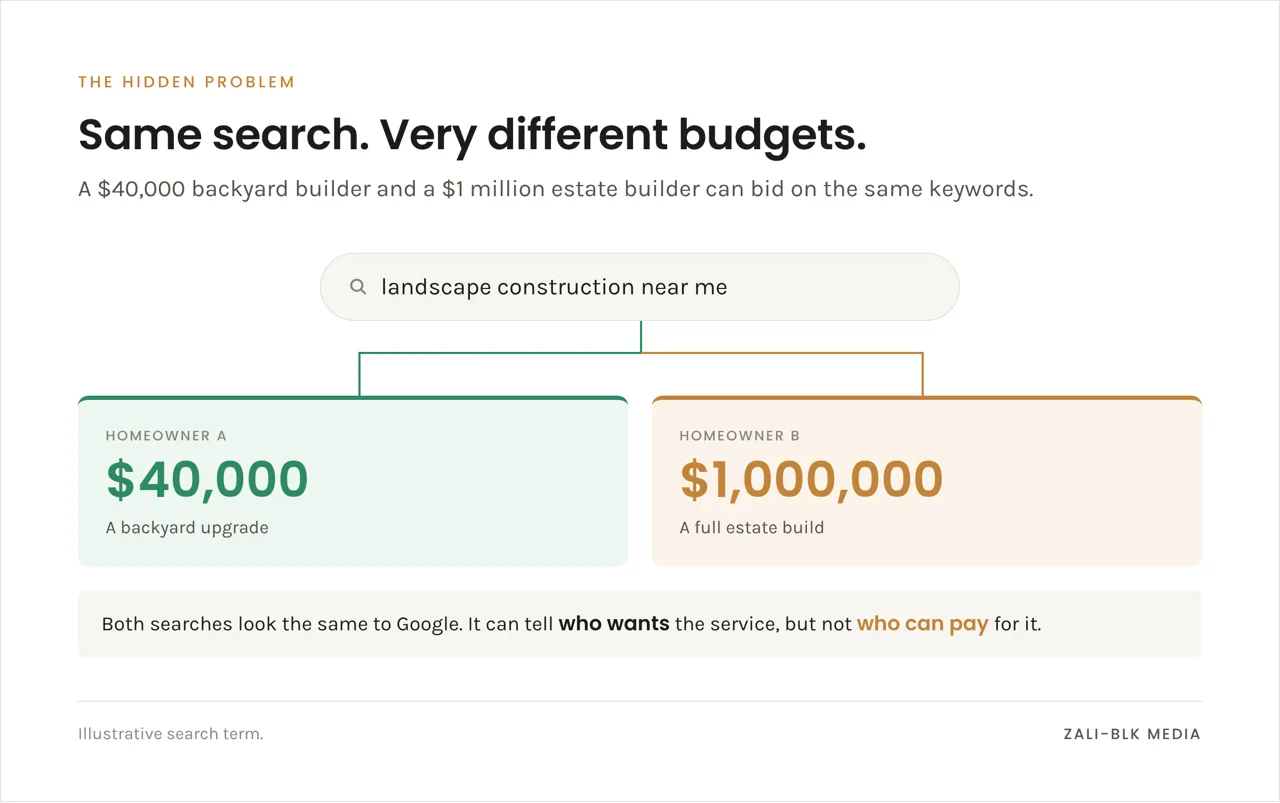
A business that builds $40,000 backyards and a business that builds $1 million estates can bid on almost the same keywords.
Both will attract people searching for landscape construction. Both will get enquiries. But only one of them is likely to find that most of those enquiries can actually afford what they sell.
That's the part of Google Ads for high-ticket businesses that rarely gets talked about.
Google is very good at finding people who want a service. It's much less able to tell you who can pay for it at your price point. The further upmarket you move, the bigger that gap becomes.
Here's how we think about it after managing campaigns for businesses with high minimum project budgets.
Every Campaign Starts With Search Intent
Good Google Ads management starts with search intent. That simply means understanding what someone is trying to do when they type a search into Google.
Someone searching "landscape construction company near me" is looking to hire. Someone searching "how to lay pavers" probably wants to do it themselves.
So the first job is to find relevant, high-intent keywords that line up with the service being advertised. Then you build ads and a landing page that match what those people are looking for.
In the early weeks, the goal isn't perfection. It's to:
- Capture relevant search traffic.
- Generate enquiries.
- Collect enough conversion data to see which keywords and search terms are producing results.
A conversion is the action you want someone to take, like submitting an enquiry form or calling the business. Without conversions coming through, you're mostly guessing about what works.
Refining the Campaign With Commercial Intent
Once a campaign has collected a reasonable amount of data, Google Ads campaign optimisation gets more precise.
You stop asking "which searches bring in enquiries?" and start asking "which searches bring in genuine business opportunities?"
This is where search intent and commercial intent start to separate.
Search intent versus commercial intent
Search intent tells you what someone is looking for. Commercial intent tells you how close they are to spending money, and how serious they are about it.
For example, "backyard ideas" and "landscape design and construct Sydney" are both about landscaping. The second search usually shows far stronger commercial intent.
Over time, you look at the search terms report, the enquiries and the jobs that were actually won. You add negative keywords to block searches that waste money. You move budget towards the keywords, locations and audiences that bring in better conversations.
The aim at this stage is a consistent flow of relevant, commercially valuable traffic.
For many businesses, this is where Google Ads starts to feel predictable. For high-ticket businesses, it's often where a new problem shows up.
Purchase Intent Is Not the Same as Purchasing Power
This is the most important idea in this article.
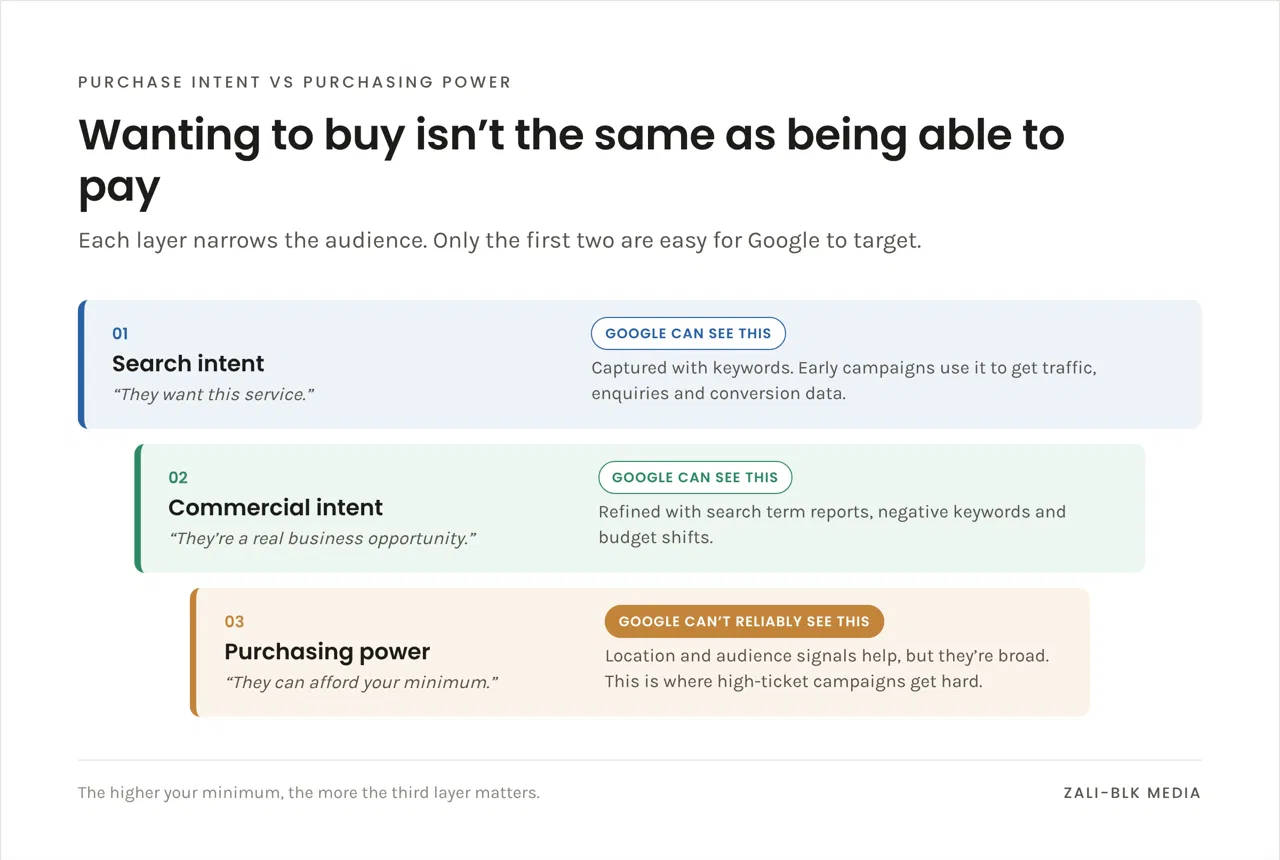
Someone searching for a home renovation, a landscape construction project or a new pool may have very strong purchase intent. They want the project. They're actively looking for someone to build it.
But wanting a project and being able to afford it at your price are two different things.
Purchase intent is the desire and readiness to buy. Purchasing power is the financial capacity to buy at a specific price point.
Google Ads can help identify people who are actively looking for a service. It can't reliably work out someone's project budget from their search behaviour alone.
Someone with $60,000 to spend and someone with $600,000 to spend can type exactly the same words into Google. They might live in the same suburb. They might click the same ad.
You can use signals like location, keywords and audience settings to lean towards a wealthier market. These help, but they're broad. They can't tell you what a particular person is prepared to spend on their backyard.
That's the hidden problem with high-ticket lead generation. Your campaign can be doing its job well, attracting people with real intent, and still produce mostly enquiries you can't take on.
A Real Example: When Most Enquiries Don't Meet the Minimum
Here's what this looked like in one of our campaigns.
The business is a high-end construction and landscaping company. It targets projects between $250,000 and $2 million.
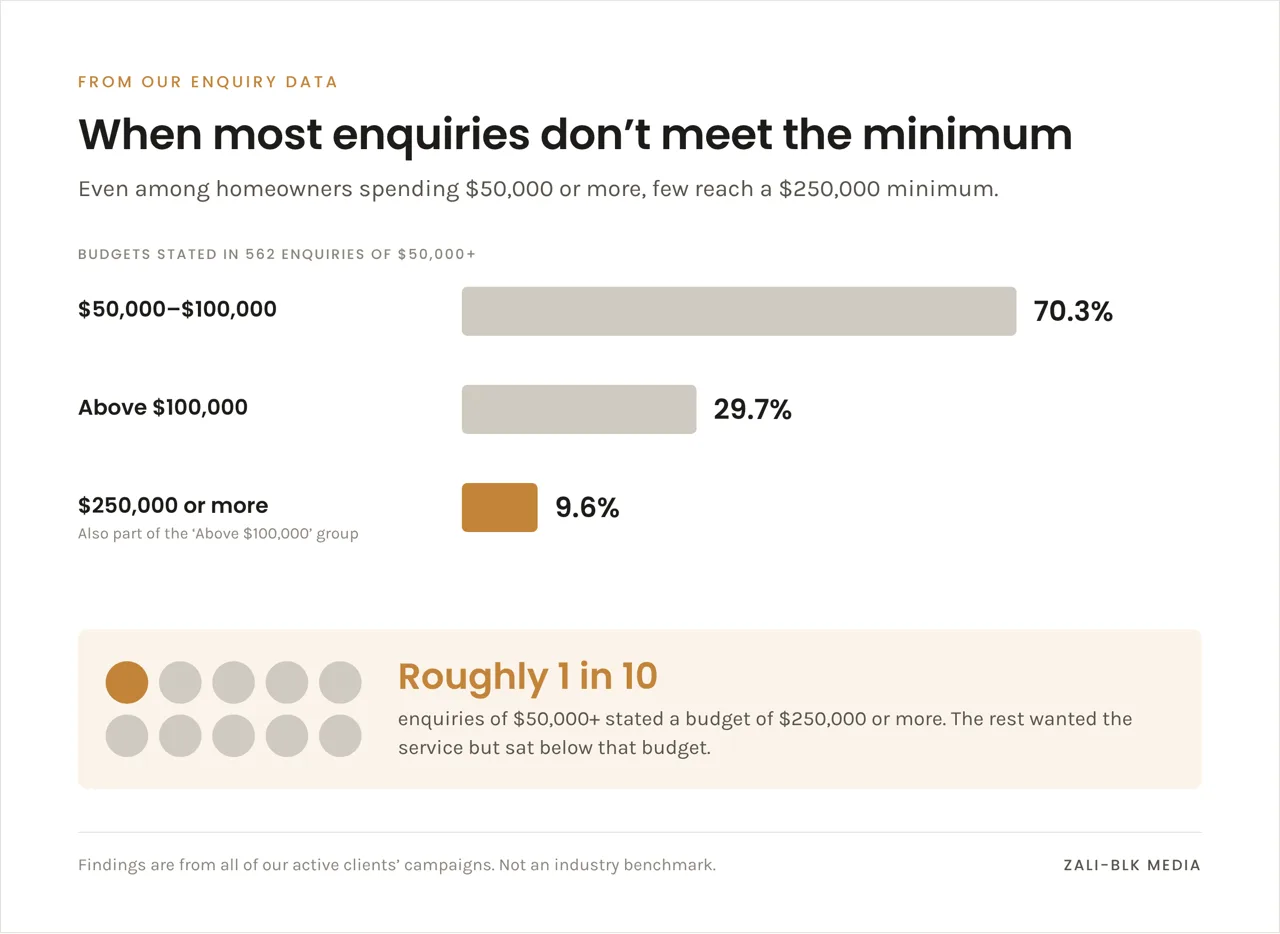
When we analysed the budgets of incoming enquiries, we found:
- Approximately 60% had budgets between $50,000 and $100,000.
- Approximately 25% had budgets above $100,000.
- Only around 6.7% had budgets of $250,000 or more.
To be clear, these figures come from one real campaign. They're not an industry benchmark, and other markets, locations and businesses will look different.
What these numbers tell us
The campaign wasn't attracting the wrong people. Most of these enquiries came from homeowners planning real projects worth tens of thousands of dollars. By most standards, those are serious buyers.
The issue was the cut-off point.
Around one in four enquiries had a budget above $100,000. But only about one in fifteen reached the $250,000 minimum the business actually wanted.
That's the pattern we see as the minimum project budget rises. The higher the minimum, the smaller the pool of people who qualify. And that pool doesn't shrink gradually. It can drop away quickly.
Even with genuine commercial intent, only a small share of searchers may meet the financial requirements of a high-end business.
Why Strict Qualification Makes Google Ads Harder to Optimise
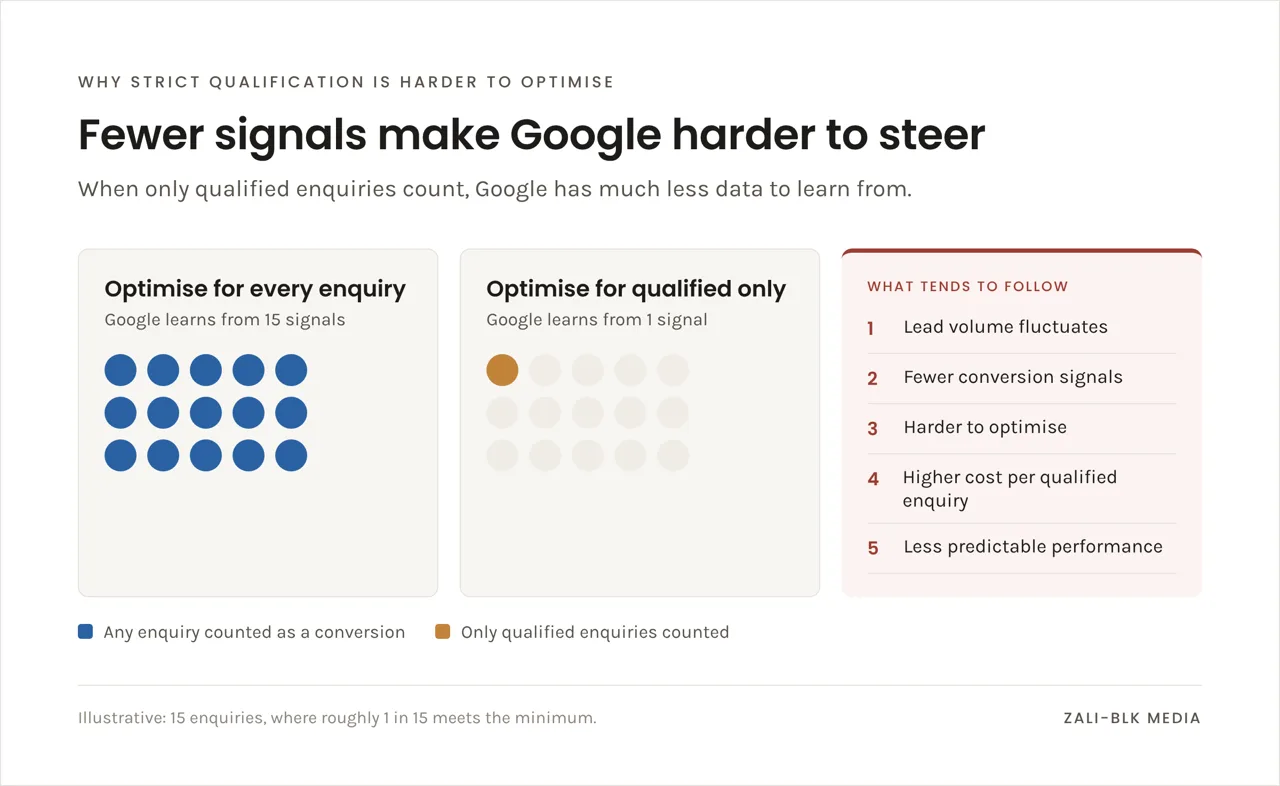
Google's automated bidding learns from conversions. Each conversion is a signal that tells Google, "this kind of search and this kind of person worked."
When a campaign produces conversions regularly, Google has more examples to learn from. It can get better at deciding which auctions to enter and how much to bid.
High-ticket businesses often want to optimise for qualified enquiries only. That's the right instinct. You don't want Google learning to find more $60,000 projects if you only build $250,000 ones.
But in the example above, only about 6.7% of enquiries reached the minimum budget. If you only count those as conversions, the number of signals Google receives drops sharply.
That can contribute to:
- More fluctuating lead volume. A good week and a quiet week can look very different.
- Fewer conversion signals. Google has less information to learn from.
- Greater difficulty optimising. It takes longer to tell whether a change actually helped or was just a random swing.
- Higher costs per qualified enquiry. You're still paying for the clicks that bring in enquiries below your minimum.
- Less predictable performance. Month-to-month results become harder to forecast.
None of this means Google Ads needs a fixed number of conversions to work. It also doesn't mean fewer conversions equal a failing campaign. Plenty of high-ticket campaigns are profitable on a small number of qualified enquiries.
It does mean there's a trade-off. Narrow the definition of a conversion too far and you get cleaner data, but less of it. Keep it too broad and you get plenty of data, but Google may learn to chase the wrong enquiries.
Part of Google Ads conversion optimisation for high-ticket businesses is finding a sensible middle ground for your situation. That might mean tracking more than one type of conversion, or giving higher value to the enquiries that meet your budget.
Why the Landing Page Matters More as You Move Upmarket
Once relevant traffic is coming through, a lot of the remaining improvement sits on the landing page.
Attracting the right search traffic is only part of the process. The landing page decides who enquires and who quietly leaves. For a high-ticket business, landing page optimisation is one of the main ways to improve Google Ads lead quality without relying on Google alone.
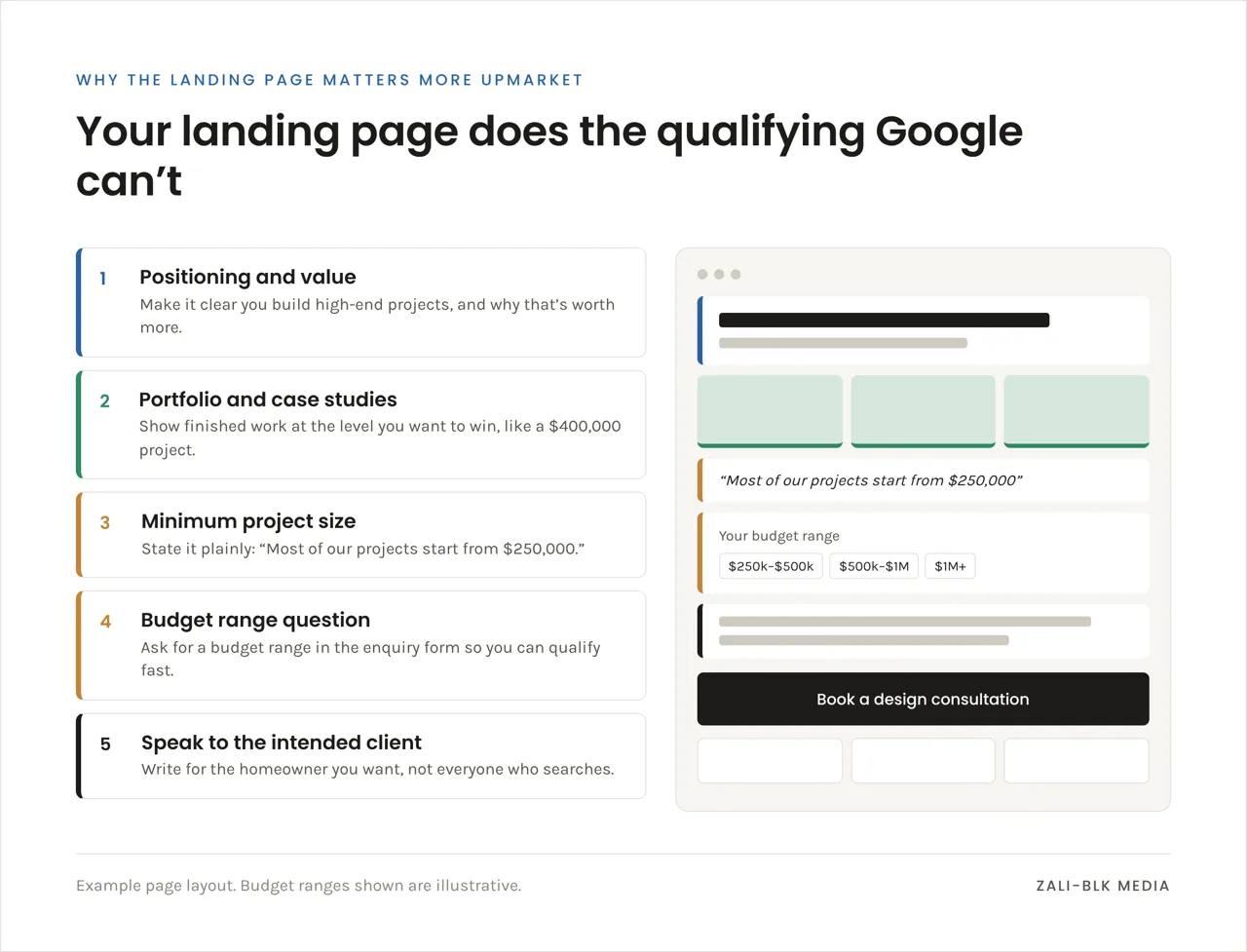
Positioning and value
Your landing page should make it obvious who you build for. A page that looks like it suits every budget will attract every budget.
Explain what makes your work worth the price. That might be design quality, project management, materials, craftsmanship or the experience of working with you. People need a reason to spend more.
Portfolio, case studies and credibility
Show the kind of projects you want more of. If your gallery is full of smaller jobs, visitors will assume that's your normal work.
Case studies help even more. A short story about a recent $400,000 project, with photos and the client's goals, tells the right visitor they're in the right place. Awards, accreditations and reviews also build trust.
Minimum project requirements and budget questions
Many high-end businesses hesitate to mention a minimum budget. They worry it will scare people off.
In our experience, it usually scares off the people you'd be turning away anyway. Phrases like "Most of our projects start from $250,000" set expectations early and save everyone time.
Adding a budget range question to your enquiry form helps too. It gives you clean data on who's enquiring, and makes it easier to track which keywords produce qualified leads.
Speaking to the intended customer
Think about who your ideal client is and what they care about.
Someone planning a $1 million build often cares about design, the process and trust more than price. A page built around "affordable" or "free quotes" sends the wrong signal to that person. Your words, images and offer should all match the customer you're trying to attract.
If you'd like more detail on matching your message to where someone is in their decision, our article on the stages of customer awareness covers it.
Why Spending More Isn't Always the Answer
When qualified enquiries are low, the natural reaction is to increase the budget.
Sometimes that works. If the campaign is limited by budget and qualified searches are being missed, spending more can help.
But a limited pool of high-value customers can't always be expanded by spending more money. If only a small number of people in your area are planning $250,000+ projects this month, a bigger budget mostly buys more clicks from people outside that group.
In that situation, the cost per qualified lead often rises rather than falls.
When results stall, the underlying problem is often one of these:
- Limited market demand. There may simply not be many buyers at that level in your service area.
- An overly restrictive minimum budget. The cut-off may be higher than the local market can support.
- Poor positioning. The landing page and brand may not be convincing the right people to enquire.
- Unrealistic expectations about volume. High-ticket campaigns often produce fewer, more valuable enquiries.
The business needs to balance four things: project value, available demand, conversion rates and customer acquisition costs.
A single $500,000 project might justify a high cost per qualified lead. A business that also takes $150,000 projects might find it has more consistent work and better campaign data. Neither answer is wrong. It depends on your margins, your capacity and the market you work in.
The Bigger Picture
Successful Google Ads management isn't just about finding keywords and generating enquiries.
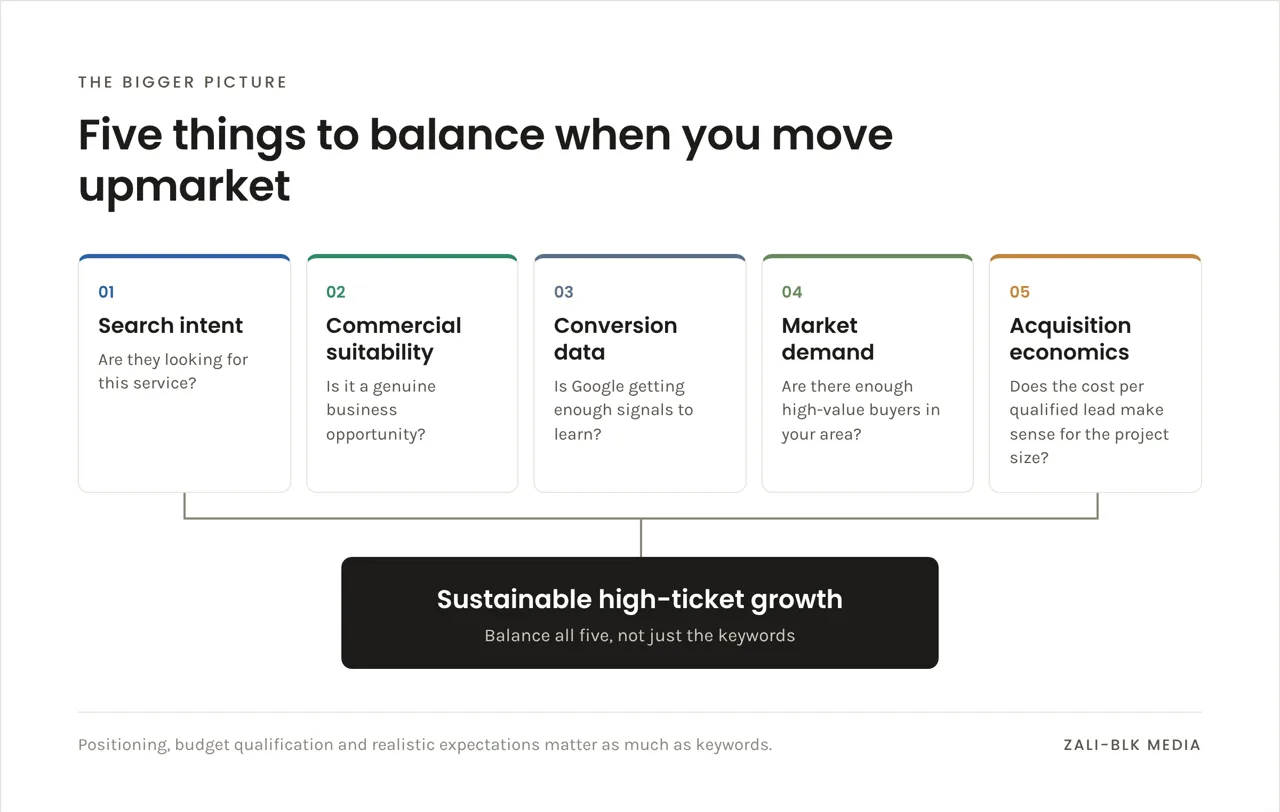
It's about understanding how several things fit together:
- Search intent: what people are looking for.
- Commercial suitability: whether they're a genuine fit for your business.
- Conversion data: whether Google has enough signals to keep learning.
- Market demand: how many qualified buyers actually exist.
- Customer acquisition economics: what you can afford to pay to win a project.
The best campaigns for high-ticket businesses attract the right opportunities while keeping enough conversion volume to support steady optimisation.
There's a real difference between finding people who want to buy a service and finding people who can afford it at your price. Once you plan around that difference, your expectations, your targeting and your landing page all start to make more sense.